

The Prophecies of Daniel: Part 6.
Chapter 7, Daniel's Four Beasts.
August 27, 2020, Updated December 30th, 2024
By JK Sellers
In "The Prophecies of Daniel: Part 6," the focus shifts to Chapter 7, where Daniel dreams of four beasts—a lion with eagle’s wings, a bear with ribs, a leopard with four heads, and a terrifying fourth beast with iron teeth and ten horns. The article interprets these as successive kingdoms: Babylon (lion), Medo-Persia (bear), Greece (leopard), and, controversially, the Seleucid Empire (fourth beast), rejecting the traditional view of Rome. It connects these symbols to Nebuchadnezzar’s statue in Daniel 2, arguing the Seleucid Empire fits the prophecy’s timeline and characteristics, like its oppression of Jews under Antiochus IV. Historical context, such as Babylonian lion motifs and Alexander’s conquests, supports this view, culminating in a divine kingdom that ends earthly rule.
Four Beasts Rising from the Sea
The First Beast, A Lion With Wings of an Eagle (Nebuchadnezzar's Babylon)
The Second Beast, A Bear with Three Ribs in His Mouth (Cyrus and the Medo-Persian Empire)
The Third Beast, A Four-Headed Leopard with Four Wings (Alexander the Great of Macedonia)
The Fourth Beast, Terrifyingly Different with Ten Horns (Antiochus IV and the Seleucid Empire)
Antiochus Epiphanes' Rise to Power
Thrones and the 'Ancient of Days'
The Little Horn is the Beast of Revelation and Will Be Destroyed
The Son of Man Receives the Keys of the Kingdom
The Interpretation from the Angel
The Little Horn and Dual Fulfillment
The Description of the Fourth Beast
Introduction
During the first year of Belshazzar's reign (550 BC), Daniel received his own first recorded vision. It had been 52 years since he first interpreted Nebuchadnezzar's dream and 57 years since he was taken from his home in Jerusalem. That would make Daniel at least 70 years old. My guess is that Daniel pondered for many years on the interpretation of Nebuchadnezzar's dream he had received years before and continually sought more information. This vision 'zooms in' or clarifies and adds understanding on the four kingdoms of Nebuchadnezzar's dream with additional information on the fourth.
It is also interesting to note that in Nebuchadnezzar's dream, everything was represented by inanimate objects. In the original dream, a great statue represented the four kingdoms that succeeded his and a stone rolling down a mountain represented the Kingdom of God. In Daniel's vision, he sees living animals representing the four earthly kingdoms and a judgement hall in heaven, with the Ancient of Days sitting upon one of the many thrones present as he gives the keys of the Kingdom of Heaven to the Son of God.
Overall View
Around the year 550 BC Daniel received a vision while lying in bed. The scene opens with the four winds churning the waters of the sea. As Daniel watched, four great beasts, each different than the next, rose from the turbulent water. The first was like a lion with the wings of an eagle. The second, looked like a bear who stood, one side taller than the other. In his teeth were three ribs. The third, appeared as a four headed leopard with four wings. The fourth beast was different than the others. This kingdom couldn't be identified as a beast from the animal kingdom. This beast had large iron teeth and ten horns. As Daniel watched a little horn grew and uprooted three of its ten horns. Daniel described this little horn as having eyes like a man and a boastful mouth.
The vision then shifts away from the beasts. Daniel sees the Son of Man, Jesus, appear out of the clouds and approach the Ancient of Days. He then gives Jesus the keys of the kingdom, the authority to rule, while multitudes worship Him.
This vision troubled Daniel. He saw what the 'little horn' would do to his people in Jerusalem and was worried for their sake. Daniel approaches one of the worshipers in the judgement hall and asks what all of this mean. The angel turned and responded that the four beasts were four kings that would rise from the earth and that the Most High, Jesus, would, in the end, possess the whole earth for all eternity.
Daniel was not totally satisfied with this answer and was still curious. He wanted to know more about the fourth beast. The angel said that the fourth beast would crush and devour its victims with iron teeth and bronze claws. He said that the little horn would wage war against the holy people and defeat them. He then gave Daniel a hint as to the little horn's identity. The fourth kingdom will have ten kings, three of these will be subdued by the little horn who will rise and suppress the Jews, change the counting of days and their laws. They would suffer for 3 ½ years' time, then be freed. After an unspecified amount of time, the kingdom of God will be given to the holy people for eternity.
Daniel was so disturbed by the vision that he was deeply troubled, and his face turned pale at the images he saw. This led to further visions, but we will cover those in later articles.
Let's now examine the vision in chapter 7 more closely.
Four Beasts Rising from the Sea
Daniel 7:1-3 (Note: All scriptures will be taken from The New International Version.)
1 In the first year of Belshazzar king of Babylon, Daniel had a dream, and visions passed through his mind as he was lying in bed. He wrote down the substance of his dream.
2 Daniel said: "In my vision at night I looked, and there before me were the four winds of heaven churning up the great sea.
3 Four great beasts, each different from the others, came up out of the sea. (Emphasis is mine.)
In the Book of Revelation, we are told that the sea can represent "peoples, multitudes, nations." (Revelation 17:15) Since John glimpsed many of the same things Daniel saw, then we can presume that the sea that Daniel beheld represented the peoples of the earth with four kingdoms rising from their midst.
Since we have identified the four kingdoms in my previous article, The Prophecies of Daniel: Part 5, Nebuchadnezzar's Image, we can easily identify the four beasts. Let's examine how they match up with Nebuchadnezzar's image.
The First Beast, A Lion With Wings of an Eagle (Nebuchadnezzar's Babylon)
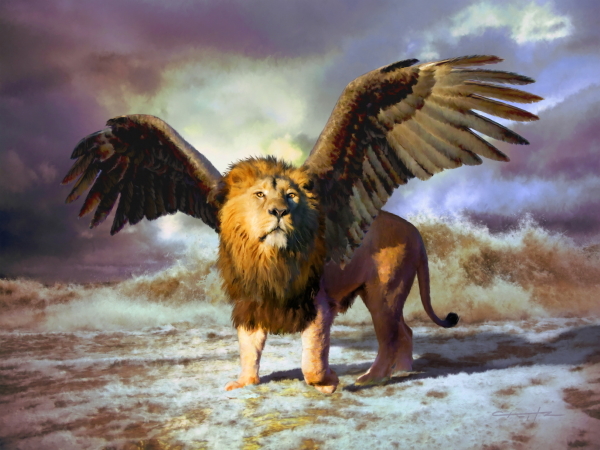
4 "The first was like a lion, and it had the wings of an eagle. I watched until its wings were torn off and it was lifted from the ground so that it stood on two feet like a human being, and the mind of a human was given to it. (Emphasis is mine.)
The lion of Babylon is an ancient and common Babylonian symbol. The lion was used to symbolically represent the king.1 The Great Precession and the Ishtar Gate in Babylon are both decorated with animal reliefs, including the Mesopotamian lion, that at one time roamed the region.

A stone relief of a Mesopotamian lion on the Ishtar Gate.
In a revelation given to Ezekiel, God used a "great eagle with powerful wings" to represent Babylon. (Ezekiel 17:3) Thus we see Babylon in Daniel's vision being represented as a lion with the wings of an eagle. In verse 17 the angel told Daniel that the four beasts represented four kings. If the first kingdom is Babylon then the king represented was most likely the founder of the Neo-Babylonian Empire, Nebuchadnezzar.
Plucked Wings and Given Intelligence of a Man
In the vision, Daniel saw that the lion's feathers were plucked from its wings and as a result he fell to the earth. While Daniel watched, it rose from the ground and stood on two feet like a man and was given intelligence like a man.
This represented an episode in Nebuchadnezzar's life. In 586 BC , Daniel interpreted a second dream for Nebuchadnezzar in which his heart would "be changed from man's, and let a beast's heart be given unto him". (Dan. 4:16) He would be driven from men, live with the beasts of the field, and eat grass like oxen. (Dan. 4:25). This Daniel warned, would happen if Nebuchadnezzar would become prideful and conceited by not recognizing God's hand in His dealing with men. (Dan. 4:25-26) Not a year later, Nebuchadnezzar boasted of his accomplishments and that it was he alone who had done the work. (Dan. 4:30) After thus boasting, a voice from heaven declared:
"This is what is decreed for you, King Nebuchadnezzar: Your royal authority has been taken from you. You will be driven away from people and will live with the wild animals; you will eat grass like the ox. Seven times will pass by for you until you acknowledge that the Most High is sovereign over all kingdoms on earth and gives them to anyone he wishes." (Dan. 4:31-32)
This is exactly what happened. Nebuchadnezzar went mad for a period of 7 years. After the 7 years were finished, he recovered and recognized God for what He had done for Babylon. He said:
"At the end of that time, I, Nebuchadnezzar, raised my eyes toward heaven, and my sanity was restored. Then I praised the Most High; I honored and glorified him who lives forever. His dominion is an eternal dominion; his kingdom endures from generation to generation." (Dan. 4:34)
Nebuchadnezzar was thus taught a great lesson in humility and the sin of pride.
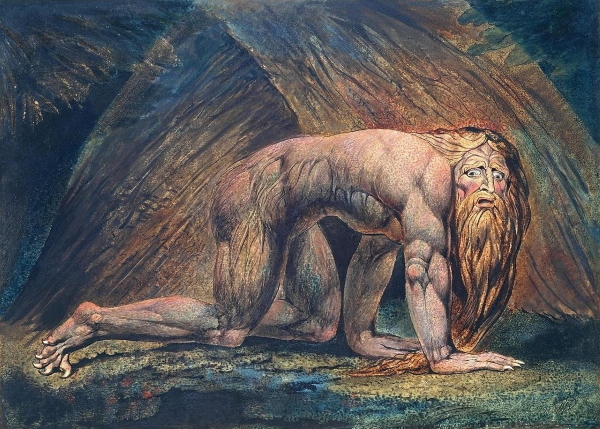
Nebuchadnezzar, by William Blake (1757–1827)
Nebuchadnezzar was the Mesopotamian lion with wings. His wings were plucked of feathers, he fell to the earth, becoming like a beast of the field with an "animal's heart". After 7 years Nebuchadnezzar rose from the ground like a man and his sanity returned to him.
The Second Beast, A Bear with Three Ribs in His Mouth (Cyrus and the Medo-Persian Empire)

5 "And there before me was a second beast, which looked like a bear. It was raised up on one of its sides, and it had three ribs in its mouth between its teeth. It was told, 'Get up and eat your fill of flesh!' (Emphasis is mine.)
The bear was considered to be, next to the lion, the strongest of the animals in the Middle East. Daniel saw the bear rise up on his hind feet, as bears often do when attacking its prey. One side was taller than the other representing the stronger Median half of the united kingdom of Medo-Persia. The shorter side would be the less influential Persia.
What did the three ribs in the bear's mouth represent?
Three Ribs
Jeremiah prophesied that Medo-Persia would conquer Babylon and warned the Israelites to flee Babylon. He said that the Medes would gather the armies of three other kingdoms, Ararat (Urartu), Minni (Mannaeans) and Ashkenaz, and easily capture the city of Babylon:
7 "Lift up a banner in the land! Blow the trumpet among the nations! Prepare the nations for battle against her; summon against her these kingdoms: Ararat, Minni and Ashkenaz. Appoint a commander against her; send up horses like a swarm of locusts.
28 Prepare the nations for battle against her— the kings of the Medes, their governors and all their officials, and all the countries they rule.
29 The land trembles and writhes, for the LORD's purposes against Babylon stand— to lay waste the land of Babylon so that no one will live there.
30 Babylon's warriors have stopped fighting; they remain in their strongholds. Their strength is exhausted; they have become weaklings. Her dwellings are set on fire; the bars of her gates are broken.
31 One courier follows another and messenger follows messenger to announce to the king of Babylon that his entire city is captured, (Emphasis is mine.)
This prophecy was fulfilled by Cyrus the Great. Prior to Cyrus' rise to power and uniting the Medians and Persians under one banner, he was given command of an army by King Astyages of Media to conquer the western and northern flanks of his empire in preparation for his final goal, to conquer their long-time enemy, Babylon.2 This included Urartu, Mannea, and Ashkenaz.3 Ararat, or Urartu, was an ancient kingdom in today's Armenia. Mannea was a kingdom just north of Media, in today's northern Iran. Ashkenaz was the first son of Gomer, a descendant of Noah. He settled in Asia Minor, present day Turkey. The kingdom of Ashkenaz was located in the central highlands of Anatolia. These three kingdoms were conquered by Cyrus and added to the Media-Persian Kingdom. Their armies marched with Cyrus the Great in the conquest of Babylon.
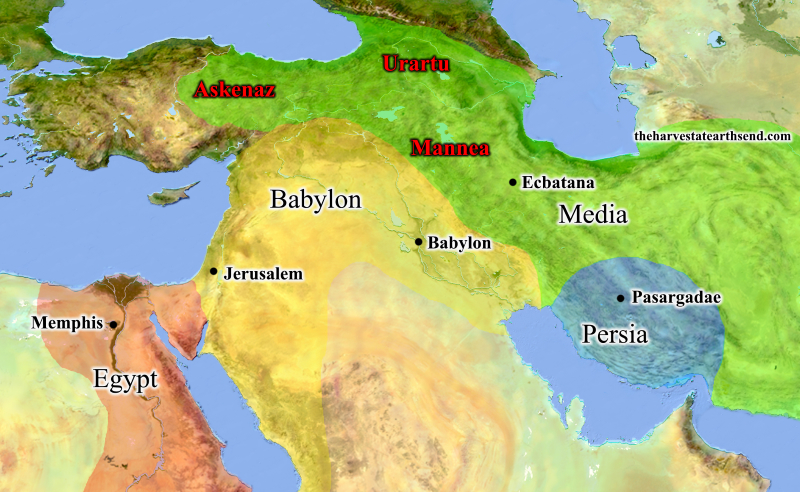
The Three Ribs in the Bear's Mouth. This map shows the conquests of Urartu, Mannea, and Ashkenaz by Cyrus just prior to the invasion of Babylon.
Thus, the bear with three ribs in his mouth was a perfect representation of Cyrus the Great leading the armies of the Media-Persian kingdom with the three smaller subject kingdoms of Urartu, Mannea, and Ashkenaz.
The Third Beast, A Four-Headed Leopard with Four Wings (Alexander the Great of Macedonia)
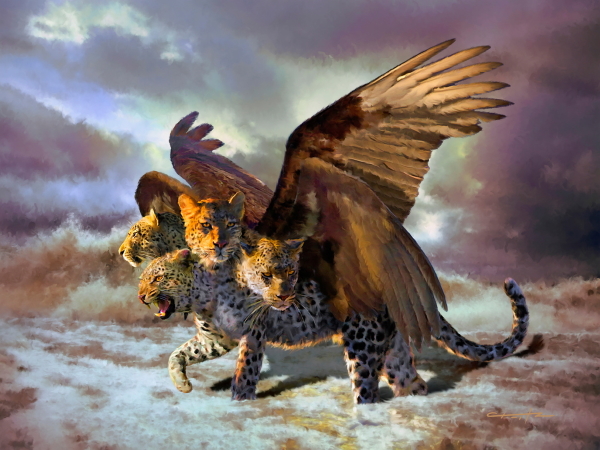
6 "After that, I looked, and there before me was another beast, one that looked like a leopard. And on its back it had four wings like those of a bird. This beast had four heads, and it was given authority to rule. (Emphasis is mine.)
The leopard with four wings and four heads represents Alexander the Great and the Macedonian Empire. The leopard is small but swift, springing suddenly on its prey. Alexander began his conquest with a relatively small army, being outnumbered at least two to one by Persia. Despite this, he was able to conquer all of Persia, Egypt, and reach as far as India.4 The four wings represented how Alexander swiftly conquered the Persian Empire in just over a decade. The four heads represent the four Diadochi, Alexander's successors, who consolidated Alexander's kingdom after his death: Cassander, Lysimachus, Ptolemy, and Seleucus.5
It was Given Authority to Rule
How could Alexander have conquered so swiftly the great Persian Empire that had plagued Macedonia for so long? Daniel says that the third beast, Alexander, was given authority to rule. Josephus records that when Alexander visited Jerusalem, with the intent to sack it, he saw something he never expected to encounter:
"As Alexander approached the city, he promised his troops that they would have the pleasure to "plunder the city and torment the high priest to death." However, when Alexander saw in the distance the multitude dressed all in white and the priests in the forefront, he did something most unexpected to his own troops and to the people of Jerusalem. Alexander rode out alone, went up to the high priest and saluted him. Whereupon the crowd from Jerusalem, "with one voice, salute(d) Alexander, and encompass(ed) him about."
In wonder, his highest-ranking officer, Parmenio, asked Alexander why he of all people was honoring the high priest of the Jews rather than having him executed. Alexander replied:
"I did not adore him, but that God who hath honored him with his high priesthood; for I saw this very person in a dream, in this very habit, when I was at Dios in Macedonia, who, when I was considering with myself how I might obtain the dominion of Asia, exhorted me to make no delay, but boldly to pass over the sea thither, for that he would conduct my army, and would give me the dominion over the Persians; whence it is that, having seen no other in that habit, and now seeing this person in it, and remembering that vision, and the exhortation which I had in my dream, I believe that I bring this army under the Divine conduct, and shall therewith conquer Darius, and destroy the power of the Persians, and that all things will succeed according to what is in my own mind."6
Alexander rode into Jerusalem with Jaddua running along at his side, not as a conqueror but as a friend. Jaddua escorted the king to the temple where he led him in offering sacrifices. He and the other priests treated Alexander "magnificently." When Jaddua showed Alexander the prophesies in Daniel, that the Greeks would destroy the Persian empire, Alexander knew that it was he that was spoken of in Daniel and that he would lead his Greek army in the downfall of Persia.7
Alexander the Great of Macedonia is the third beast. He suddenly sprang upon Persia and conquered the entire region from the Mediterranean coast all the way into India in 12 short years. Alexander was instructed in a dream, inspired by God, to conquer the Persians.
The Fourth Beast, Terrifyingly Different with Ten Horns (Antiochus IV and the Seleucid Empire)

7 "After that, in my vision at night I looked, and there before me was a fourth beast—terrifying and frightening and very powerful. It had large iron teeth; it crushed and devoured its victims and trampled underfoot whatever was left. It was different from all the former beasts, and it had ten horns.
8 "While I was thinking about the horns, there before me was another horn, a little one, which came up among them; and three of the first horns were uprooted before it. This horn had eyes like the eyes of a human being and a mouth that spoke boastfully. (Emphasis is mine.)
Note: Before we go into the identity of the fourth beast, we must first consider that the vision of Daniel differs in viewpoint with Nebuchadnezzar's dream. This vision is seen by an Israelite whose allegiance lies in Jerusalem and its Temple, hundreds of miles to the west, not in Babylon. On the other hand, Nebuchadnezzar was concerned about his kingdom and his own legacy. Daniel was concerned more about his own people, the worship of his God, and the eventual return of the Jews back to Jerusalem and the reconstruction of the Temple.
Since the first, second and third beasts represented the first three kingdoms of Nebuchadnezzar's dream, then we can reason that the fourth kingdom of the dream is the same as the fourth beast of Daniel, the Seleucid Empire.8 Let's see if they match.
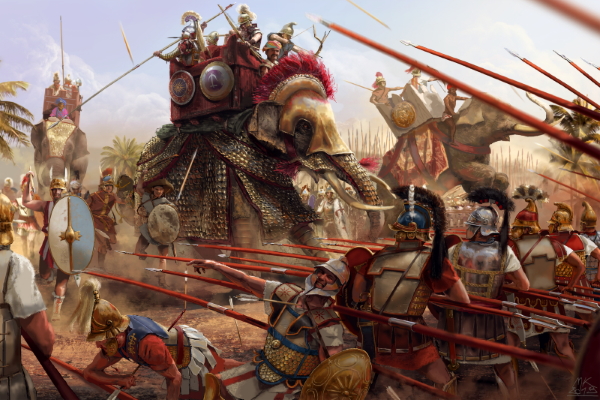
Diadochi Wars by Manuel Krommenacker
What Daniel saw in his vision frightened and terrified him. This fourth beast was very powerful. It crushed its victims and trampled them underfoot, and devoured them with iron teeth. This is a perfect description of how Indian war elephants were taught to wade into infantry formations, spin around, crushing the men with its feet, goring with spikes or swords attached to their tusks, and grabbing others with its trunk to fling them away. The Seleucid armies never had a numerical advantage of heavy infantry as the other Diadochi armies had, but they did have a large force of mounted archery from Parthia. The biggest advantage the Seleucid armies had over their rivals was the greater number of armored, Indian war elephants, the armored tanks of ancient warfare. With hundreds of war elephants in their military formations, the Seleucid kingdom certainly did "trample underfoot" and "crush" their victims and "devoured them with iron teeth".
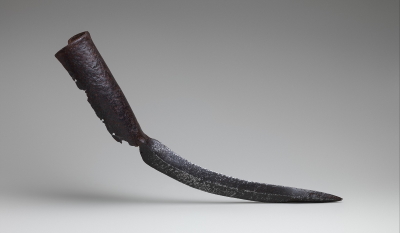
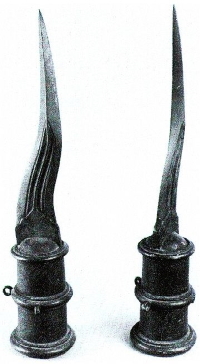
Elephant tusk weapons. The "iron teeth" of the fourth beast.
The Seleucid Empire is the fourth kingdom with "large iron teeth", who "crushed and devoured its victims and trampled (them) underfoot!"
The fourth beast was so different that it did not represent anything from the animal kingdom. It had ten horns, three of which were uprooted and replaced by another, a smaller horn. This little horn had eyes like a human with a boastful mouth. How could this possibly represent the Seleucid Empire?
In Daniel chapter 7 verse 24 we learn that the 10 horns represent 10 kings. If the Seleucid empire is the fourth beast, then we can easily test this by going back into history and finding who were the 10 kings and which one supplanted three of them by becoming the little horn. Here is a list of kings you will find in your history books, beginning with Seleucus I to Antiochus IV Epiphanes:
- Seleucus I Nicator, first king of Seleucid Empire, 312-280 BC
- Antiochus Soter, son of Seleucus Nicator, 280-261 BC
- Antiochus Theos, son of Antiochus Soter, 261-247 BC
- Seleucus Callinicus, son of Antiochus Theos, 247-226 BC
- Alexander, or Seleucus Ceraunus, son of Seleucus Callinicus, 226-223 BC
- Antiochus the Great, brother of Seleucus Ceraunus, 223-187 BC
- Seleucus Philopater, son of Antiochus the Great, 187-176 BC
- Antiochus Epiphanes, brother of Seleucus Philopater, 176-164 BC
Throughout history Antiochus Epiphanes has been identified as the little horn. However, he is eighth in line of Seleucid kings so how can he be the 10th? Did he replace three kings? If he did, who were they? Let us examine history to see how Antiochus gained the throne.
Antiochus the Great
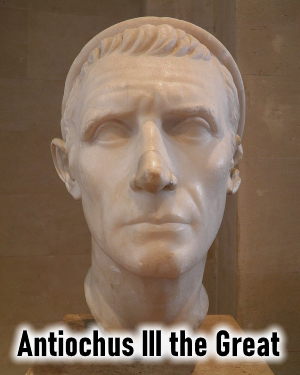
Bust of Antiochus the Great in the Louvre Museum
Antiochus Epiphanes' father was King Antiochus the Great (241-187 BC). He received that title for his expansion of the kingdom he received after the death of his brother, Seleucus Ceraunus. In the intervening years between the first Seleucid king, Seleucus I, to the time of Antiochus the Great, the Seleucid kingdom had shrunk in size and power. Antiochus successfully campaigned in the east retaking much of present-day Iran, north into Armenia, west into Europe and Macedonia, and south all the way to the Red Sea. Antiochus saw victory after victory with his army which was made up of the Greek phalanx, cavalry, and of course, the Indian war elephants. His success ended when he met the rising power of Rome. He fought a 4-year war against Rome and was finally defeated by Scipio at the Battle of Magnesia (188 BC), where his army was decimated and surrendered to the Romans.
Surrender terms were discussed, and a treaty was signed. The Treaty of Apamea that Antiochus was forced to sign was crippling to his kingdom. He was forced to retreat from Europe and much of Asia Minor, destroy all his elephant who participated in the battle, reduce his navy to a mere 12 ships, pay a penalty of 3,000 talents plus 1,000 more each year for the next 12 years, plus turn over 20 hostages, his son, young Antiochus Epiphanes, being one of them.
Antiochus the Great died three years later, campaigning in the east. His son, Seleucus Philopater, was co-rulers at the time of his father's death and rose to the throne. After replacing Antiochus the Great as king, Seleucus' brother, Antiochus, was released as a hostage in Rome and replaced by the next heir to the throne, the new king's son, Demetrius Soter, aged 10. Antiochus was no longer of value as a hostage since the king had two sons who were ahead of Antiochus in the royal succession, Demetrius Soter and young Antiochus.
Seleucus Philopater was given a much-weakened Seleucid Kingdom. To pay the punishing war-indemnity of 1,000 talents each year he inherited from his father, Seleucus went about taxing and plundering his people and their temples. One of which was the Temple in Jerusalem, where Seleucus Philopater sent his highest-ranking military leader and minister, Heliodorus, to loot the fabled treasures of the Temple.
The story of Heliodorus and his attempt to rob the Temple is recorded in 2 Maccabees chapter 3. As Heliodorus and his soldiers forced their way into the Temple, an angel wearing golden armor appeared in his path. This fierce angel was mounted on a great war horse who reared up and struck Heliodorus down with his hooves. Once down, two other angels appeared and "flogged him unceasingly" until he passed out. Heliodorus' men placed him on a stretcher and begged the high priest to spare his life. The high priest prayed humbly to God and asked Him to spare Heliodorus' life. Which he did and Heliodorus quickly recovered.
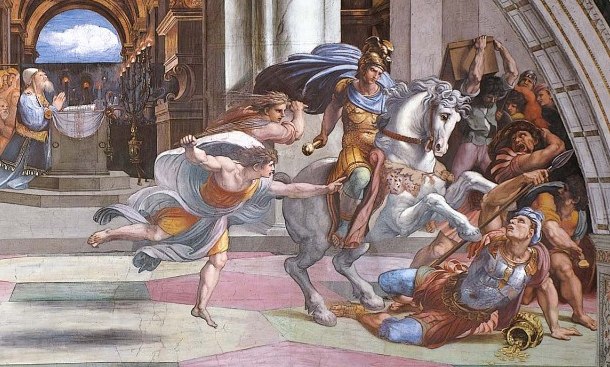
Expulsion of Heliodorus from the Temple, by Raphael, 1513
On his return, Heliodorus told his king, Seleucus Philopater, what had happened. The king then asked who he should send next to plunder the Temple at Jerusalem. Heliodorus responded:
"If you have an enemy or one who is plotting against the government, send him there, and you will get him back with a flogging, if indeed he survives at all; for there is certainly some divine power about the place. The one whose dwelling is in heaven watches over that place and protects it, and strikes down and destroys those who come to harm it."
Not long after this event in 175 BC, Heliodorus assassinates the king, Seleucus Philopater, and seizes the throne for himself.9 Technically, Heliodorus would be king number 8, not Antiochus Epiphanes. So why is it that historian do not count Heliodorus in the line of Seleucid kings? One reason is that he was a usurper and had no relationship to the Seleucid dynasty and thus was not in line for the crown. The other would be that his reign on the throne was very brief, lasting just a few short months.
Antiochus Epiphanes' Rise to Power
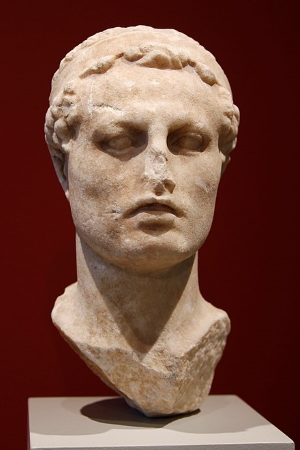
Bust of Antiochus IV at the Altes Museum in Berlin.
After being released by the Romans, Antiochus spent a dozen years in Athens until word of his brother's assassination reached him. Antiochus saw an opportunity to take the kingdom for himself. He immediately traveled to Syria, killed Heliodorus, and seized the throne. He did this by marrying his brother's widow, who happened to be his own sister. He then declared himself regent to his young nephew, completely bypassing Demetrius Soter, the oldest son and heir of the dead king who was conveniently, a hostage in Rome. Thus, Antiochus killed the usurper and passed over a presumptive to the throne, Demetrius Soter. A few years later he had his young regent killed. By devious planning and assassination, Antiochus Epiphanes, became sole ruler of Seleucia.
The Three Horns Uprooted by the Little Horn
- Heliodorus the usurper, who assassinated King Seleucus Philopater. Then executed by Antiochus IV Epiphanes.
- Demetrius Soter, son of Seleucus Philopater was to inherit the throne but was in Rome as a hostage. His throne was usurped by Antiochus Epiphanes.
- Young Antiochus was the second in line. Antiochus Epiphanes proclaimed himself his regent then had the boy assassinated.
Antiochus IV is the little horn that uprooted three of the horns (kings) of the fourth beast, the Seleucid Empire.
Eyes of a Human Being and a Mouth that Spoke Boastfully
"This horn had eyes like the eyes of a human being and a mouth that spoke boastfully."
The Old Testament often refers to the "eyes of man" as his wisdom, intelligence or cunning. (Gen. 3:5, Ps. 19:8, Jeremiah 5:21, Ecclesiastes 2:14). Antiochus Epiphanes was certainly a cunning man and renowned for his craftiness and deceit. After learning that Heliodorus had killed his brother and usurped the throne, Antiochus somehow convinced his family's enemy, King Eumenes II of Pergamum, to help him get from Athens, through a hostile Asia Minor and to the capital, Antioch, and ascend the throne. Antiochus even persuaded Eumenes to provide him with a military detachment to get through the other opposing kingdoms in Asia Minor! Once in Syria proper, he was able to make his way to the capital and kill the usurper, Heliodorus. Antiochus then persuaded the king's widow, his own sister, Laodice, to marry him in order to give him some semblance of legitimacy to take the throne. He arrogantly proclaimed himself the young Antiochus' regent. No one knows how he was able to convince the queen, the military and ministerial leaders, and the populace that he was the legitimate king of the Seleucid kingdom when the king's heir, Demetrius, was still alive and in Rome.
Antiochus IV truly did have the cunning "eyes of a man" with a tongue "that spoke boastfully" and persuasively!
Thrones and the 'Ancient of Days'
9 "As I looked, "thrones were set in place, and the Ancient of Days took his seat. His clothing was as white as snow; the hair of his head was white like wool. His throne was flaming with fire, and its wheels were all ablaze.
10 A river of fire was flowing, coming out from before him. Thousands upon thousands attended him; ten thousand times ten thousand stood before him. The court was seated, and the books were opened. (Emphasis is mine.)
Daniel's vision now shifts. He sees thrones being set up.10 Upon one of them, the 'Ancient of Days'11 sits. He is dressed all in white with white hair. The throne is shining like it's on fire as well as the "wheels" of the thrones. Ezekiel, a contemporary of Daniel, had a similar experience in his vision of the throne room of God (Ezekiel Chapter 1). The flowing of fire and the open books denote the judgement of the four wicked kingdoms that Daniel saw and their predecessors that will arise in the future.
Daniel's vision is different from Ezekiel's in several ways. First, Ezekiel saw the throne room of God while Daniel saw a judgement hall with many thrones. Also, Ezekiel's vision is one where he is called to teach and warn Israel. Daniel, on the other hand, was shown the pronouncement of judgement upon earthly kingdoms and the delivery of the keys of the Kingdom of Heaven to Jesus Christ.
The Little Horn is the Beast of Revelation and Will Be Destroyed
11 "Then I continued to watch because of the boastful words the horn was speaking. I kept looking until the beast was slain and its body destroyed and thrown into the blazing fire.
12 (The other beasts had been stripped of their authority, but were allowed to live for a period of time.) (Emphasis is mine.)
It should be noted that the little horn is a type for the beast that John saw in his visions recorded in the 13th chapter of Book of Revelation. Antiochus IV is the ultimate archetype for the anti-Christ of John's Revelation. History often repeats itself. And so it will again in the last days.
Daniel sees the judgement that is passed on to the little horn as well as the beast of Revelation which it represents in the last days and is destroyed. This is the destruction of the wicked prior to the Second coming as recounted by John in Revelation chapter 19.
The Son of Man Receives the Keys of the Kingdom
13 "In my vision at night I looked, and there before me was one like a son of man, coming with the clouds of heaven. He approached the Ancient of Days and was led into his presence.
14 He was given authority, glory and sovereign power; all nations and peoples of every language worshiped him. His dominion is an everlasting dominion that will not pass away, and his kingdom is one that will never be destroyed. (Emphasis is mine.)
Jesus Christ is the son of man or the Son of God (Acts 7:55-56) as declared in the New Testament. He receives the keys of the Kingdom from the Ancient of Days in preparation of the Millennium. There he shall rule and reign forever!
The Interpretation from the Angel
15 "I, Daniel, was troubled in spirit, and the visions that passed through my mind disturbed me.
16 I approached one of those standing there and asked him the meaning of all this. "So he told me and gave me the interpretation of these things:
17 'The four great beasts are four kings that will rise from the earth.
18 But the holy people of the Most High will receive the kingdom and will possess it forever—yes, for ever and ever.' (Emphasis is mine.)
Daniel did receive some comfort when he learned that God and his people would triumph in the last days and win the kingdom forever. However, he was more concerned about his own people in the near future and of Jerusalem and the Temple of God. Daniel approaches one of the angels standing before the thrones and asked for understanding as to what Daniel saw in the vison. The angel tells Daniel that the four beasts represent four kings (Nebuchadnezzar, Cyrus, Alexander, and Antiochus IV), and that the Savior will overthrow them all and rule the Kingdom of God forever.
The Little Horn and Dual Fulfillment
19 "Then I wanted to know the meaning of the fourth beast, which was different from all the others and most terrifying, with its iron teeth and bronze claws—the beast that crushed and devoured its victims and trampled underfoot whatever was left.
20 I also wanted to know about the ten horns on its head and about the other horn that came up, before which three of them fell—the horn that looked more imposing than the others and that had eyes and a mouth that spoke boastfully.
21 As I watched, this horn was waging war against the holy people and defeating them,
22 until the Ancient of Days came and pronounced judgment in favor of the holy people of the Most High, and the time came when they possessed the kingdom. (Emphasis is mine.)
Daniel wanted to know the identity of the fourth beast. He already knew what this terrifying beast would do to Israel; "crush and devour its victims and trample underfoot whatever was left." The vision even gave some hints as to the identity of this beast. That he would be the tenth king of the Seleucid Empire and would overthrow three others to gain his throne. He also described this king perfectly, Antiochus IV Epiphanes, as being "more imposing" and who "had eyes and a mouth that spoke boastfully". The most concerning thing to Daniel was that this king would wage war against Israel and defeat them.
In verse 22 the angel informs Daniel that this will continue until Christ receives the keys to the kingdom. How can this be? Antiochus died long before Christ was born and even millennia before the time when the wicked are destroyed and the Savior is handed over the keys to the kingdom. So how can this be describing Antiochus Iv and the Seleucid Empire and their war against the Jews in Jerusalem?
Many scholars believe that this is an instance of a prophecy with dual or multiple fulfillments, where a prophecy can be fulfilled more than once in history or in the future. For example in Isaiah chapter 10 the destruction of Assyria is a type of the destruction of the wicked at the Second Coming. And so, it is in Daniel, Antiochus IV is an archetype for the Beast of Revelations who will be destroyed at the last days after which the holy people of God will possess the kingdom of God.
The Description of the Fourth Beast
23 "He gave me this explanation: 'The fourth beast is a fourth kingdom that will appear on earth. It will be different from all the other kingdoms and will devour the whole earth, trampling it down and crushing it.
24 The ten horns are ten kings who will come from this kingdom. After them another king will arise, different from the earlier ones; he will subdue three kings.
25 He will speak against the Most High and oppress his holy people and try to change the set times and the laws. The holy people will be delivered into his hands for a time, times and half a time.
26 " 'But the court will sit, and his power will be taken away and completely destroyed forever. (Emphasis is mine.)
The angel now gives Daniel a detailed description of the fourth kingdom. It will be different from the other three. He tells Daniel that this kingdom would conquer "the whole earth" by trampling and crushing its enemies. This is clearly referring to Antiochus' Seleucid Kingdom. Antiochus was the only one of the four kings to order the destruction of the Jewish religion and way of life through terror, enslavement, and slow and painful executions. In addition, trampling and crushing its enemies is a perfect description of how the Seleucid armies used their Indian war elephants in battle.
As shown above, Antiochus was the eleventh king of Seleucid Empire after usurping the throne from three other rightful rulers; Heliodorus the Usurper, Demetrius Soter, son of Seleucus Philopater, and Young Antiochus. Antiochus' IV meteoric rise to the throne of the Seleucid Kingdom was a direct fulfillment of Daniel's prophecy.
Antiochus continued to fulfill Daniel 7 to the letter in other ways. While returning from a less than successful campaign in Egypt, Antiochus IV, was notified that the Jews had rebelled against the High Priest who he himself had installed in Jerusalem. The previous High Priest, Jason, had heard a rumor that Antiochus had been killed in the fighting in Egypt. Jason saw a chance to remove the wicked and corrupt High Priest and raised a force of a thousand men who then threw out Menelaus. Many of the faithful priests and Jews in Jerusalem opposed the wickedness that Menelaus brought into Jerusalem. The High priest had led the people to break their covenants with God. What's worse, in order to gain favor with their Greek rulers, the priests had accepted pagan practices and worship. The most egregious, being the practice of homosexuality and pedophilia that was the norm in Greek culture. He introduced Gymnasiums into Jerusalem where homosexuality and pedophilia were practiced. Many Jewish leaders and priests participated in this activity to flatter the Greek hierarchy. All participants went nude, so the leaders and priest somehow disguised their circumcisions to fit in with the uncircumcised Greeks.12
When Antiochus heard of the revolt, he immediately led his army to Jerusalem. The Greek soldiers quickly stormed Jerusalem and sacked the city. This is how it is described in 2 Maccabees:
"Raging like a wild animal… He ordered his soldiers to cut down without mercy those whom they met and to slay those who took refuge in their houses. There was a massacre of young and old, a killing of women and children, a slaughter of young women and infants. In the space of three days, eighty thousand were lost, forty thousand meeting a violent death, and the same number being sold into slavery… Antiochus carried off eighteen hundred talents from the temple and hurried back to Antioch."13
Shortly thereafter, Antiochus began a campaign to eradicate Jewish culture and religion:
- He plundered the Temple and stripped it bare of its treasure and furnishings, and as Josephus says, "left nothing at all remaining".14
- He looted the city and set fire to it, demolished many houses and Jerusalem's surrounding walls.15
- Desecrated the Temple by sacrificing swine on its sacred altar and then making. broth and sprinkling it around the Temple.16
- He killed and enslaved tens of thousands.17
- Banned the daily sacrifices in the Temple.18
- Erected a statue of Jupiter on the Temple's altar and forced all to worship it.19
- Tortured and crucified any who would not deny their faith in God.20
- Turned the rooms of the Temple into a public brothel.21
- Put to death any woman who had their child circumcised by hanging the baby from her neck and then throwing them both off the high wall of the city.22
- Destroyed any copy of the scriptures that were found and executed those hiding them.23
- He forced the Jews to adhere to Greek customs on pain of death.24
Antiochus IV, in his effort to completely Hellenize the Jews, forced them to abandon their calendar of Holy Days and Feasts and adopt the Greek calendar, thus fulfilling another prediction of Daniel that he would "change the set times and the laws"(Dan. 7:25).25
A Time, Times, and Half a Time
The Angel gave another specific detail that points to no other person than Antiochus IV Epiphanes. The duration of the campaign of terror was to be 3 ½ years long. The Aramaic word !dd[ (`iddan) means time or year.26
Samuel Driver, an English divine and Hebrew scholar, who contributed to the Cambridge Bible for Schools and Colleges, wrote that the beginning of the 3 ½ years:
". . . began with the mission of Apollonius against Jerusalem, probably about June 168, and with the edict of Antiochus which was immediately afterwards put in force (1Ma 1:20-53); and it ended (substantially) with the re-dedication of the Temple, after its three years' desecration, on the 25th of Chisleu [Dec.], 165 (1Ma 4:52 f.)." (Driver, Samuel Rolles, Cambridge Bible for Schools and Colleges, Cambridge University Press, 1882, Daniel 7:25.)
The 3½ years ended in December of 164 BC27 when the Maccabees rededicated the temple. That same month, Antiochus died a horrible death. Thus, the Jews were delivered from his hands after 3 ½ years and his power was "taken away and completely destroyed" (Dan. 7:25).
Kingdom of God
27 Then the sovereignty, power and greatness of all the kingdoms under heaven will be handed over to the holy people of the Most High. His kingdom will be an everlasting kingdom, and all rulers will worship and obey him.'
28 "This is the end of the matter. I, Daniel, was deeply troubled by my thoughts, and my face turned pale, but I kept the matter to myself." (Emphasis is mine.)
Daniel saw that even though the four kingdoms, Babylon, Persia, Macedonia, and Seleucid, would fall and fade into history, the people would survive and continue. Today the modern countries of Iraq, Iran, Turkey, Saudi Arabia, and Syria have replaced these ancient kingdoms. Daniel was told that these kingdoms would lose their "power (and) will be taken away and completely destroyed." All the power of the kingdoms of this earth will be handed over to the saints and the Savior and that "all the rulers will worship and obey him."
Even with the assurance that Christ and His holy people will overcome all in the end, Daniel was not mollified. He was fearful of what was coming in the form of the little horn, Antiochus, and the terrible acts he will perpetrate upon the people of Jerusalem, the desecration of the Temple, and the prevention of Israel from keeping their covenants with God. Daniel says that his face turned pale and he did not discuss his troubling vision with others. However, he did continue to worry on this topic and as a result received several more visions on the matter. Those will be discussed in upcoming articles.
Summary
What we learn from Daniel's vision:
- In this vision Daniel was given more information on the identity of the four kingdoms, the fourth kingdom in particular.
- In verse 17 we learn that each beast may also represent each of the kings.
- The lion with wings represents Nebuchadnezzar of Babylon.
- The bear with three ribs in his mouth represents Cyrus the Great of the Medo-Persian Empire.
- The four-headed leopard with four wings represents Alexander the Great of Macedonia and the four Diodachi (successors).
- The beast with ten horns is the Seleucid Empire and the little horn that replaced three others represents Antiochus IV, who took the throne by displacing a usurper to the throne and two rightful heirs.
How Antiochus IV Fulfills Daniel 7
Here is a list of the descriptions of the little horn in Daniel chapter 7 and how Antiochus fulfills each of them:
"It had large iron teeth" and "crushed and devoured its victims and trampled underfoot"
This is a perfect description of how the Seleucid armored war elephants, who had swords mounted on to their tusks, were used to wade into infantry formations, gore, crush and trample their enemies.
"different from all the other kingdoms"
The Seleucid Empire was Greek in origin. It was a western kingdom and very different culturally from the oriental nations of Babylon, Media and Persia. The Seleucid Empire, throughout its history, attempted the Hellenization of their oriental subjects in order to unify and develop a common bond between the many differing peoples.
"will devour the whole earth"
Daniel uses this phrase liberally rather than literally, since he used the same words to describe the much smaller Babylon Kingdom (Dan. 4:1) and the Macedonia Empire of Alexander the Great (Dan. 2:39). Neither conquered the "whole earth". If taken literally, Nebuchadnezzar and Alexander would have conquered China, Europe, Asia, North and South America, etc. But they didn't. Neither did Antiochus IV. However, Antiochus did lead his armies from Egypt in the south to Greece in the west and to India in the east, just as Cyrus and Alexander had.
"ten horns are ten kings who will come from this kingdom"

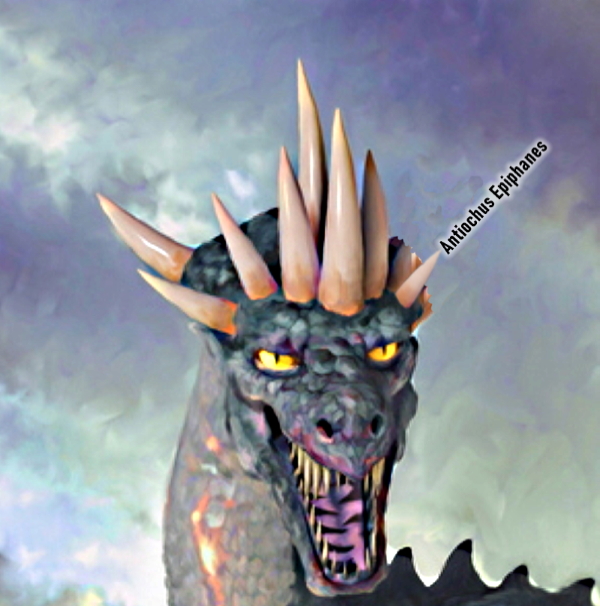
The ten horns (kings) of the Seleucid Empire before the rise of the little horn:
- Seleucus I Nicator, first king of Seleucid Empire, 312-280 BC
- Antiochus Soter, son of Seleucus Nicator, 280-261 BC
- Antiochus Theos, son of Antiochus Soter, 261-247 BC
- Seleucus Callinicus, son of Antiochus Theos, 247-226 BC
- Alexander, or Seleucus Ceraunus, son of Seleucus Callinicus, 226-223 BC
- Antiochus the Great, brother of Seleucus Ceraunus, 223-187 BC
- Seleucus Philopater, son of Antiochus the Great, 187-176 BC
- Heliodorus the Usurper, assassinated King Seleucus Philopater. Was then executed by Antiochus IV Epiphanes, 176 BC, only ruled for a few months.
- Demetrius Soter, son of Seleucus Philopater was the rightful heir to the throne after his father's assassination. His throne was usurped by Antiochus Epiphanes. Did not rule until after the death of Antiochus IV.
- Young Antiochus was the next in line after his older brother, Demetrius Soter. Antiochus Epiphanes proclaimed himself his regent then had the boy assassinated several years later before he was old enough to rule on his own.
- The Little Horn: Antiochus Epiphanes, brother of Seleucus Philopater, 176-164 BC
"another king will arise, different from the earlier ones; he will subdue three kings"
How was Antiochus different than his predecessors?
Antiochus IV was the first Seleucid king to use divine epithets on coins, such as "manifest god" and "bringer of victory".
Antiochus IV was the first ruler in the kingdom's history to usurp the authority from a direct descendant. The president he set began the process of the eventual disintegration of the kingdom into several civil wars and its ultimate demise.
Even though all the other kings of the Seleucid Empire adopted a Hellenization program to unite their kingdom, none were as vicious and destructive as Antiochus IV. No other king or kingdom went to the extent Antiochus did to eradicate the Jewish religious practices and scripture. Antiochus IV subdued three kings to usurp the throne: Heliodorus, Demetrius Soter, and Young Antiochus.
"speak against the Most High"
Antiochus certainly did speak against God when he defiled the Temple, placed an idol on the altar and forced all to worship it. He stopped the daily sacrifice, turned the Temple into a brothel, burned every copy of the scriptures he could find and killed those who attempted to hide them. Yes, Antiochus IV certainly did "speak against the Most High."
"oppress his holy people"
Antiochus not only oppressed the people of God, he persecuted them, slaughtered them by the thousands and enslaved thousands more. He pillaged the Temple as well as Jerusalem and burned down many buildings and tore down the walls of the city.
"try to change the set times and the laws"
Antiochus forced the Jews to recant their religion and stop using their own calendar with its holy days and adopt the Greek calendar and system for telling time.
"The holy people will be delivered into his hands for a time, times and half a time"
Antiochus' persecution of the Jews lasted exactly 3 ½ years as Daniel predicted, from June of 168 BC to December of 164 BC.
There is little doubt that Antiochus IV Epiphanes is the little horn of Daniel 7 and that the fourth kingdom is the Seleucid Kingdom!
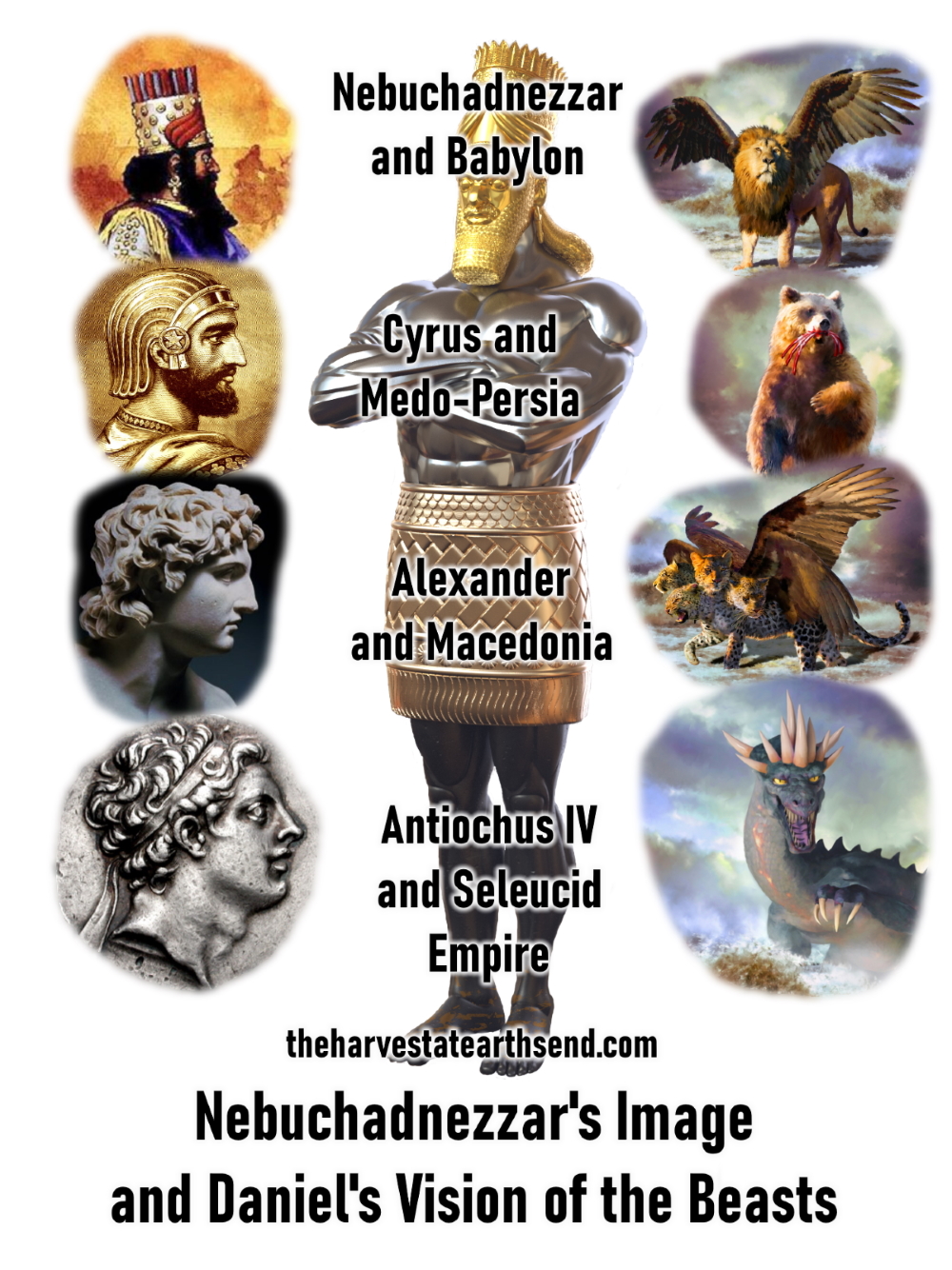
Nebuchadnezzar's Image and Daniel's Vision of the Beasts: This illustration shows the kings represented in Daniel's vision on the left, Nebuchadnezzar's image in the center with the kingdoms listed, and the corresponding beasts on the right.
Notes:
- Sass, Benjamin; Marzahn, Joachim. Aramaic and figural stamp impressions on bricks of the sixth century B.C. from Babylon. Otto Harrassowitz Verlag, 2010. Pp. 181-182.
- Xenophon, Translated By Henry Graham Dakyns, CYROPAEDIA, THE EDUCATION OF CYRUS, BOOK I, C.1.
- Rollinger, Robert, The Median Empire, the end of Urartu and Cyrus the Greats Campaign in 547 BC, pp. 60-61.
- Sellers, JK, The Prophecies of Daniel: Part 5, Nebuchadnezzar's Image: The Rise of Alexander the Great.
- Sellers, JK. The Prophecies of Daniel: Part 5, Nebuchadnezzar's Image: The Last Four Diadochi
- Josephus, Flavius, Antiquities of the Jews — Book XI, Chapter 6, 5
- Sellers, JK, The Prophecies of Daniel: Part 3, Daniel and Alexander the Great
- Sellers, JK, The Prophecies of Daniel: Part 5, Nebuchadnezzar's Image; The Fourth Kingdom, the Legs of Iron
- Rawlinson, George, A Manual of Ancient History, 1880, 256
- In the King James Version verse 9 states: "I beheld till the thrones were cast down, and the Ancient of days did sit…" The Benson Commentary of the Bible explains the more proper use of set rather than cast down. "… the word רמיו, here used, maybe rendered, were pitched, or placed, namely, for the reception of God, and his assessors in judgment, the saints and angels. Thus the LXX., εως οτου οι θρονοι ετεθησαν, till the thrones were placed, or set, or fixed; and so the Vulgate. And the verb in the text is used in the same sense in the Chaldee paraphrase on Jeremiah 1:15; where our translation reads, They shall set every one his throne, etc."
- Ancient of Days. The great majority of Bible scholars agree that the Ancient of Days referred to by Daniel is Jehovah. It is interesting that Daniel is the only prophet to refer to God using the term, "Ancient of Days". Another aspect to consider is that the Ancient of Days sits on one of many thrones while, when Jehovah is seen on a throne, his is usually the only one present. Multiple thrones are mentioned when judgement is offered. This includes the 12 Apostles who will judge the world. (Rev. 20:4, Luke 22:30) In LDS theology the Ancient of Days is Adam who will collect all of the keys of the Kingdom that were given from the beginning to the end and hand them over to the Savior in the last days.
- Homosexuality in Ancient Greek. From Facts and Details.Com
- 2 Maccabees 5:11-21
- Josephus, Flavius, Antiquities of the Jews, Book XII, Ch. 5, 4
- 1 Maccabees 1: 31
- 1 Maccabees 1:47
- 2 Maccabees 5:11-14
- Josephus, Flavius, Antiquities of the Jews, Book XII, Ch. 5, 4
- 2 Maccabees 6:2
- 2 Maccabees 6:6-9
- 2 Maccabees 6:4
- 1 Maccabees 1:60-61; 2 Mac. 6:10
- 1 Maccabees 1:56-57
- 1 Maccabees 1:44-50
- Vanderkam, J.C., 2 Maccabees 6, 7A And Calendrical Change in Jerusalem, Journal for the Study of Judaism in the Persian, Hellenistic, and Roman Period, Vol. 12, No.1 (1981) pp. 52-74
- Brown, Driver, Briggs and Gesenius. "Hebrew Lexicon entry for `iddan (Aramaic)". "The KJV Old Testament Hebrew Lexicon"
- What Is The Meaning Of 'A Time, Times And Half A Time'? From Bible Studies, The Scriptures UK.
JK Sellers
Coming Soon: The Prophecies of Daniel: Part 7, The Ram, Goat and the Little Horn.
See also:
The Prophecies of Daniel: Part 1, The Historical Setting
The Prophecies of Daniel: Part 2, Who was Daniel
The Prophecies of Daniel: Part 3, Daniel and Alexander the Great.
The Prophecies of Daniel: Part 4. Chapter 9, 70 Weeks-The Coming of the Messiah.
The Prophecies of Daniel: Part 5. Chapter 2 Nebuchadnezzar's Image.
The Prophecies of Daniel: Part 7. Chapter 8, The Ram, Goat and the Little Horn.
The Prophecies of Daniel: Part 8. Chapters 10-12, The Wars of the Kings of the North and the South.
The Prophecies of Daniel Part 9. Daniel's Fourth Beast was not Rome. It was the Seleucid Empire.